Jaw Flexible Couplings
In the realm of mechanical power transmission, the jaw flexible coupling stands as one of the most versatile and widely utilized components, serving as a critical bridge between driving and driven shafts across countless industrial systems. Unlike rigid couplings that demand perfect shaft alignment and offer no tolerance for operational irregularities, jaw flexible couplings are engineered to balance reliable torque transmission, misalignment compensation, vibration damping, and shock absorption, making them indispensable for maintaining the stability and longevity of rotating machinery. This comprehensive exploration delves into the intrinsic structural design, core performance attributes, diverse classification criteria, and extensive practical applications of jaw flexible couplings, highlighting their unique advantages and adaptability to varied operational environments.

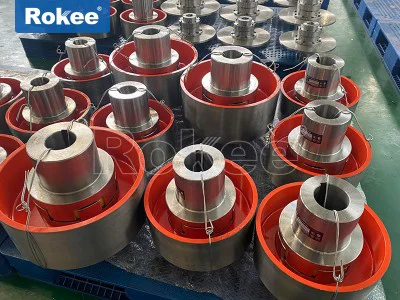
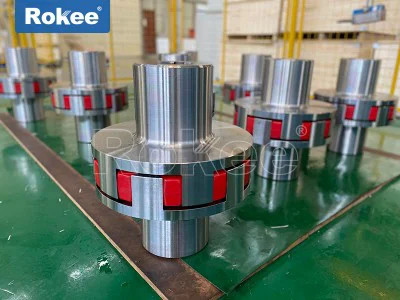
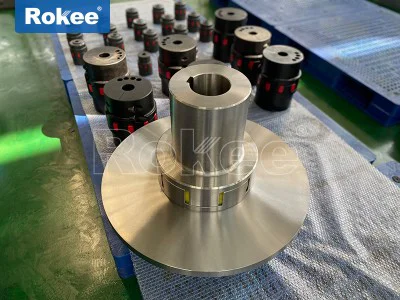
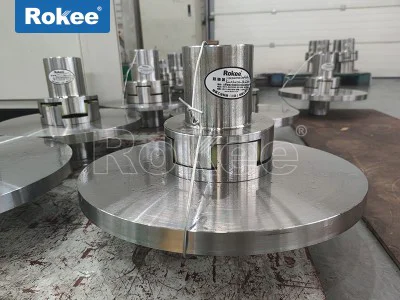
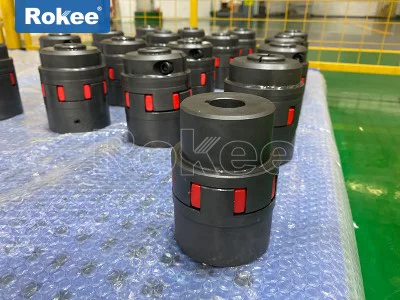
At its core, the jaw flexible coupling features a remarkably simple yet robust structural composition, typically consisting of three fundamental components: two metallic hubs and an elastomeric insert commonly referred to as a spider. This three-piece construction is the foundation of its functionality, with each element engineered to fulfill a distinct role in power transmission and system protection. The metallic hubs, crafted from high-strength materials such as carbon steel, alloy steel, cast iron, or aluminum alloy, are precision-machined with evenly spaced protruding jaws around their inner circumferences. These jaws are designed to interlock alternately with the lobes of the elastomeric spider, creating a secure meshing structure that facilitates torque transfer without direct metal-to-metal contact under normal operating conditions. The geometry of the jaws varies across designs, with straight jaws and curved jaws being the two predominant profiles, each tailored to specific performance requirements; straight jaws offer ease of manufacturing and radial installation of the spider, while curved jaws enhance contact area, distribute stress more uniformly, and enable zero-backlash operation in precision-driven setups.
The elastomeric spider is the heart of the jaw flexible coupling, dictating much of its flexible performance characteristics. Molded from durable polymer materials such as nitrile rubber (NBR), polyurethane, Hytrel, or other synthetic elastomers, the spider features a lobed, star-like shape that fits snugly between the jaws of the two hubs. This elastomeric element acts as a cushion and a flexible medium, absorbing torsional vibrations, mitigating shock loads, and accommodating shaft misalignments that inevitably occur in real-world machinery operation. The material properties of the spider—including hardness, elasticity, temperature resistance, and chemical stability—directly shape the coupling’s overall performance, allowing for customization to suit diverse operational demands. Beyond the core three components, some jaw flexible coupling variants incorporate additional features such as protective covers to shield the internal spider and jaws from dust, moisture, debris, and corrosive substances in harsh working environments, while others may include specialized locking mechanisms to ensure stable hub-shaft connection without slippage during high-torque or high-speed operation.
The performance of jaw flexible couplings is defined by a set of key attributes that set them apart from other coupling types, making them suitable for a broad spectrum of industrial applications. Foremost among these is their ability to transmit torque efficiently across a wide range of loads, from low-power light-duty machinery to heavy-duty industrial equipment handling substantial rotational forces. The torque transmission mechanism relies on compressive force applied to the elastomeric spider lobes by the interlocking jaws; as the driving hub rotates, it pushes the spider lobes, which in turn transfer motion to the driven hub, ensuring smooth power delivery without abrupt jolts. This compression-based torque transfer not only enhances load-bearing capacity but also reduces wear on internal components compared to shear-based flexible couplings, as elastomers exhibit higher structural integrity under compression than under shear stress.
Misalignment compensation is another pivotal performance feature of jaw flexible couplings, addressing the common challenge of imperfect shaft alignment in mechanical assemblies. No industrial shaft system can achieve absolute perfect alignment during installation or maintain it under operational stress, and uncompensated misalignment can lead to excessive bearing wear, increased energy consumption, premature component failure, and system downtime. Jaw flexible couplings are engineered to accommodate three primary types of shaft misalignment: angular misalignment, parallel (radial) misalignment, and axial misalignment. The elastomeric spider’s flexibility allows for slight angular deflection between the two shafts, radial offset without imposing excessive radial loads on bearings, and limited axial movement to compensate for thermal expansion or minor shaft displacement. While the degree of misalignment tolerance varies by coupling size and spider material, this capability significantly reduces the precision required for shaft alignment during installation, lowering assembly costs and simplifying maintenance procedures.
Vibration and shock absorption capabilities further elevate the practical value of jaw flexible couplings, protecting sensitive drive components from damage caused by operational vibrations, sudden load changes, or mechanical shocks. In rotating machinery, torsional vibrations generated by uneven torque output, reciprocating motion, or sudden start-stop cycles can propagate through the shaft system, causing fatigue failure in gears, bearings, motors, and gearboxes. The elastomeric spider acts as a natural damper, absorbing and dissipating vibrational energy and reducing the amplitude of torsional oscillations, thereby minimizing noise levels and extending the service life of connected equipment. Additionally, in scenarios involving sudden shock loads—such as abrupt load increases or emergency stops—the spider’s elastic deformation cushions the impact, preventing shock waves from damaging critical components and maintaining system stability. This damping effect is particularly valuable in systems where smooth operation and component protection are prioritized, as it isolates the driving and driven ends from harmful dynamic forces.
A notable safety and reliability feature of jaw flexible couplings is their fail-safe design, a characteristic that distinguishes them from many other elastomeric flexible couplings. In the event that the elastomeric spider deteriorates, wears out, or fails completely due to prolonged use, overloading, or environmental damage, the metallic jaws of the two hubs will interlock directly, much like the teeth of a gear, to continue transmitting torque. This ensures that the machinery does not suffer an immediate, catastrophic shutdown, allowing for controlled operation until maintenance can be performed to replace the damaged spider. While this fail-safe operation results in increased noise, reduced damping, and potential accelerated wear on the jaws, it prevents unplanned downtime in critical applications, offering a window for scheduled repairs and minimizing productivity losses. It is important to note that this fail-safe function is inherent to standard jaw coupling designs, whereas shear-style elastomeric couplings lack this feature, as spider failure in those designs results in complete torque loss.
Additional performance merits of jaw flexible couplings include low maintenance requirements, electrical isolation, and broad operational adaptability. Unlike gear couplings or chain couplings that demand regular lubrication to prevent friction and wear, jaw flexible couplings operate without the need for lubrication, as the elastomeric spider eliminates direct metal-to-metal contact under normal conditions. This dry-running design reduces ongoing maintenance costs, eliminates the risk of lubricant leakage and contamination, and simplifies upkeep routines. The elastomeric spider also provides effective electrical isolation between the driving and driven shafts, preventing the transmission of stray electrical currents that can cause corrosion, sparking, or damage to electronic components integrated into the machinery. Furthermore, jaw flexible couplings exhibit strong resistance to moderate environmental stressors, including temperature fluctuations, moisture, and certain chemical exposures, with spider material selection enabling customization for extreme temperature ranges or harsh industrial atmospheres.
Jaw flexible couplings are categorized into distinct types based on multiple criteria, including jaw geometry, spider design, hub configuration, and intended application, each tailored to meet specific operational needs and performance expectations. The most fundamental classification is based on jaw profile, dividing couplings into straight jaw flexible couplings and curved jaw flexible couplings. Straight jaw couplings feature flat, linear jaws and are the standard, cost-effective design for general-purpose power transmission; they allow for radial installation and removal of the spider without disassembling the entire coupling or disturbing shaft alignment, making them ideal for routine maintenance and applications where backlash is not a critical concern. Curved jaw couplings, by contrast, have contoured, rounded jaws that mate precisely with the spider lobes, enabling preloading of the elastomer to eliminate backlash entirely. This zero-backlash characteristic makes curved jaw couplings the preferred choice for precision motion control systems, servo mechanisms, and equipment requiring accurate positioning, such as machine vision systems, robotic assemblies, and precision machining tools, though they are less suited for continuous high-load scanning motions that demand greater torsional rigidity.
Classification by spider design further expands the versatility of jaw flexible couplings, with four primary spider variants catering to different spatial and operational constraints: standard solid-center spiders, open-center spiders, snap-wrap spiders, and load cushion spiders. Standard solid-center spiders are the most widely used, featuring a fully enclosed central core that provides stable support for the lobes, ensuring balanced load distribution and suitability for high-speed operation across general industrial applications. Open-center spiders have a hollow central design, reducing the axial space required between shaft ends and making them ideal for compact machinery with limited shaft gap; however, this design has lower speed ratings due to reduced structural support, restricting use to moderate rotational speeds. Snap-wrap spiders feature a perimeter-connected, open-end design that allows for quick radial installation without hub disalignment, streamlining maintenance in confined spaces, though they require retaining rings or collars to secure the spider in place. Load cushion spiders consist of separate, individual elastomeric blocks instead of a single integrated unit, enabling easy replacement of worn cushions in heavy-duty applications and facilitating targeted maintenance without full coupling disassembly.
Jaw flexible couplings can also be classified by hub mounting style, adapting to diverse shaft connection requirements in different machinery setups. Common hub configurations include set screw hubs, clamping hubs, keyway hubs, and expansion sleeve hubs. Set screw hubs feature threaded screws that lock the hub to the shaft, offering simple installation but suitable only for light to moderate loads to prevent shaft damage. Clamping hubs utilize a split-hub design with clamping bolts to create a uniform, friction-based grip around the shaft, providing a secure, non-marring connection ideal for high-torque and high-speed applications. Keyway hubs incorporate precision-machined keyways that mate with shaft keys, ensuring positive torque transmission and preventing slippage under heavy loads, commonly used in heavy industrial machinery. Expansion sleeve hubs rely on friction generated by tapered expansion sleeves to connect the hub and shaft, delivering exceptional torque capacity, concentricity, and ease of installation, suitable for high-performance, heavy-duty equipment.
Beyond structural and design-based classifications, jaw flexible couplings are also grouped by performance capacity, ranging from light-duty miniature couplings for small precision devices to heavy-duty industrial couplings for large-scale manufacturing and processing equipment. Light-duty models are compact, often crafted from aluminum alloy for reduced inertia, suitable for low-power motors, pumps, fans, and instrumentation equipment. Medium-duty couplings strike a balance between torque capacity and flexibility, serving as the workhorse for general industrial machinery such as conveyors, mixers, and centrifugal pumps. Heavy-duty couplings feature robust steel hubs and reinforced elastomeric spiders, engineered to handle extreme torque loads, high rotational speeds, and harsh operating conditions in heavy industry, including mining machinery, metal processing equipment, and large-scale material handling systems.
The exceptional combination of structural simplicity, reliable performance, and adaptable design makes jaw flexible couplings one of the most widely applied power transmission components across nearly every industrial sector. Their versatility allows them to integrate seamlessly into an extensive array of machinery, addressing diverse operational needs from low-precision, light-duty equipment to high-precision, heavy-duty systems. In the manufacturing and assembly industry, jaw flexible couplings are ubiquitous in machine tools, automated production lines, robotic arms, and conveyor systems, where they ensure smooth torque transmission, compensate for assembly-related misalignment, and dampen vibrations to maintain production accuracy and efficiency. In precision motion control applications, curved jaw zero-backlash couplings are essential for servo motors, linear actuators, and measuring equipment, enabling precise positioning and rapid stop-start cycles without positional error.
The fluid handling industry relies heavily on jaw flexible couplings for pump and compressor systems, including centrifugal pumps, gear pumps, reciprocating compressors, and blower units. These couplings absorb the vibrations inherent in fluid transfer operations, compensate for shaft misalignment caused by pump mounting or thermal expansion, and protect motor and pump bearings from premature wear, reducing maintenance frequency and enhancing operational reliability. In the HVAC and refrigeration sector, jaw flexible couplings are used in fans, blowers, and compressor motors, where their vibration damping capabilities reduce noise pollution and ensure quiet, efficient operation of climate control systems in commercial, residential, and industrial buildings.
Heavy industrial sectors such as mining, construction, and metalworking depend on heavy-duty jaw flexible couplings to withstand extreme loads, shock impacts, and harsh environmental conditions. In mining equipment, including crushers, conveyors, and grinding mills, these couplings endure heavy shock loads and continuous operation, with their fail-safe design preventing costly downtime in remote mining operations. Construction machinery such as mixers, compactors, and drilling equipment utilizes jaw flexible couplings to handle uneven terrain-induced misalignment and sudden load fluctuations, maintaining power transmission stability in rugged working environments. Metal processing equipment, including rolling mills, cutting machines, and forging presses, relies on the high torque capacity and vibration resistance of jaw flexible couplings to sustain consistent performance under intense operational stress.
The automotive and transportation industries also leverage jaw flexible couplings in various applications, from engine auxiliary systems and transmission components to material handling vehicles. In automotive manufacturing assembly lines, they facilitate precise motion control for welding, painting, and assembly robots, while in forklifts, pallet jacks, and other industrial vehicles, they provide reliable power transmission between drive motors and wheels, absorbing shocks from uneven warehouse floors. Additionally, jaw flexible couplings find extensive use in food and beverage processing, pharmaceutical manufacturing, and packaging machinery, where their lubrication-free design prevents product contamination, and easy maintenance aligns with strict hygiene and operational efficiency standards.
Agricultural machinery benefits significantly from the durability and adaptability of jaw flexible couplings, which are integrated into tractors, harvesters, irrigation systems, and grain processing equipment. These couplings withstand the dust, moisture, and variable loads of agricultural operations, compensating for misalignment caused by rough terrain and absorbing shocks from fieldwork, ensuring consistent performance in challenging outdoor environments. In the energy and power generation sector, jaw flexible couplings are employed in generators, wind turbine auxiliary systems, and power transmission equipment, where they dampen torsional vibrations from power sources, protect generator components, and maintain stable power output, even under fluctuating load conditions.
The widespread adoption of jaw flexible couplings across such diverse industries stems from their unique ability to balance core functional requirements: efficient torque transmission, effective misalignment compensation, reliable vibration damping, and low maintenance demands. Their modular, simple design not only reduces initial manufacturing and assembly costs but also simplifies replacement and repair, minimizing long-term operational expenses. While no single coupling type can fulfill every industrial requirement, jaw flexible couplings offer an unparalleled combination of versatility, reliability, and cost-effectiveness, making them a staple in mechanical engineering design. As industrial technology continues to advance, with increasing demands for precision, efficiency, and durability in rotating machinery, the jaw flexible coupling remains a critical component, evolving alongside material science and engineering innovations to meet the ever-changing needs of modern industrial systems.