Claw Type Flexible Couplings
In the realm of mechanical power transmission, the claw type flexible coupling stands as a versatile and widely adopted component, bridging driving and driven shafts while addressing common operational challenges such as misalignment, vibration, and shock loads. Unlike rigid couplings that demand perfect shaft alignment and offer no tolerance for dynamic fluctuations, this type of coupling integrates rigid torque transmission capabilities with elastic flexibility, making it a staple in countless industrial systems across diverse sectors. Its design is rooted in simplicity and functional efficiency, with a modular construction that balances durability, ease of installation, and cost-effectiveness, catering to both standard and moderately demanding operating environments. Every aspect of its structure, from core components to geometric configurations, is engineered to optimize power transfer, mitigate mechanical stress, and prolong the service life of connected machinery, solidifying its position as a foundational element in modern mechanical engineering.
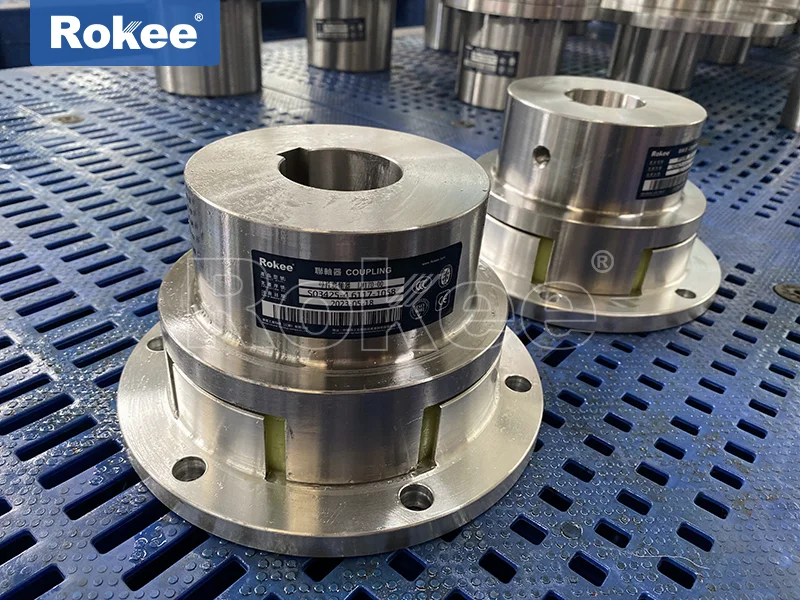
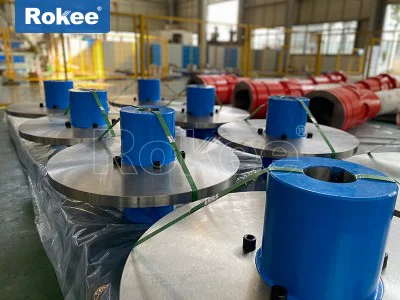
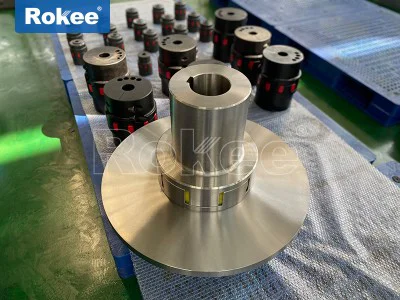
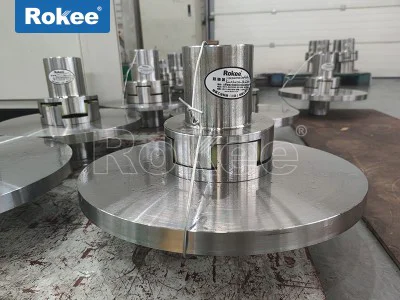
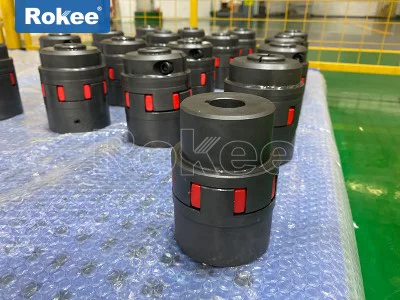
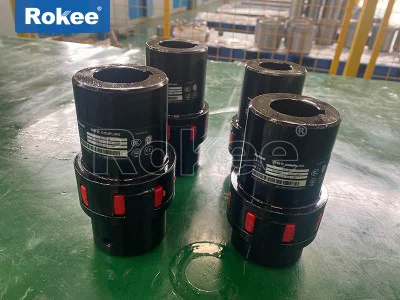
At its core, the claw type flexible coupling features a straightforward yet robust structural composition, typically consisting of two metallic hub halves and a central elastic insert, with no overly complex moving parts that would compromise reliability. The two hub halves are precision-engineered components, each equipped with evenly spaced, protruding claw-like teeth arranged radially around the inner bore designed to fit onto the shaft surfaces. These claws are machined to tight tolerances, ensuring uniform contact and load distribution when mated with the elastic element, and are crafted from high-strength materials such as carbon steel, alloy steel, cast iron, or lightweight aluminum alloy, depending on the intended load capacity and operational speed. Carbon steel hubs are favored for heavy-duty, high-torque applications due to their exceptional tensile strength and resistance to wear, while aluminum alloy hubs are preferred in lightweight, high-speed systems where reduced rotational inertia is critical. The elastic insert, often referred to as a spider or cushion, sits snugly between the two sets of claws, filling the gaps between opposing teeth to create a flexible connection. This insert is manufactured from elastomeric materials including polyurethane, natural rubber, synthetic rubber, or high-performance engineering plastics, each selected for unique mechanical properties that define the coupling’s overall performance. The geometric design of the claws varies across models, with standard straight claws, curved claws, and contoured claws being the most prevalent; curved and contoured claws enhance contact area with the elastic insert, reducing stress concentrations and improving load-bearing capacity, while straight claws offer simplicity in manufacturing and cost efficiency for light to medium-duty use.
The operational principle of the claw type flexible coupling is centered on the synergistic interaction between the rigid metallic hubs and the deformable elastic insert, enabling seamless torque transmission alongside misalignment compensation and vibration damping. When the driving shaft rotates, torque is transferred from the driving hub’s claws to the elastic insert, which deforms slightly under compressive force to pass the rotational energy to the driven hub’s claws, ultimately rotating the driven shaft. This elastic deformation is not merely a means of power transfer; it is the key to the coupling’s flexible characteristics. Unlike rigid couplings that transfer shock loads and misalignment stresses directly to shafts and bearings, the elastic insert absorbs and dissipates these harmful forces, safeguarding sensitive mechanical components. The coupling is engineered to accommodate three primary forms of shaft misalignment: angular misalignment, radial misalignment, and axial misalignment, each within predefined limits that vary based on the size of the coupling and the properties of the elastic insert. Angular misalignment, where the two shafts are tilted at a slight angle relative to one another, is compensated by the uneven compression of the elastic insert across its circumference. Radial misalignment, involving a lateral offset between the shaft centerlines, is addressed by the lateral flexibility of the elastomer, which allows the hubs to move slightly without creating excessive radial loads. Axial misalignment, referring to endplay or longitudinal movement of the shafts, is managed by the axial compressibility of the insert, preventing binding or excessive thrust forces on the shaft bearings. This multi-directional misalignment compensation is a defining performance trait, eliminating the need for ultra-precise shaft alignment during installation and reducing maintenance requirements over time.
Performance-wise, the claw type flexible coupling excels in a spectrum of mechanical attributes that make it suitable for a broad range of operating conditions, with key metrics including torque transmission capacity, torsional stiffness, damping efficiency, temperature resistance, and wear resistance. Torque transmission capability varies significantly across different sizes and designs, ranging from small-scale couplings for low-power precision equipment to heavy-duty variants for large industrial machinery, with torque ratings scaling proportionally with the coupling’s outer diameter, claw size, and material strength. One of the most notable performance features is its exceptional vibration and shock damping ability, a direct result of the viscoelastic properties of the central insert. The elastomer material absorbs vibrational energy generated by uneven rotation, gear meshing, or sudden load changes, converting mechanical vibration into minimal thermal energy that dissipates harmlessly, thereby reducing noise levels and preventing resonant vibrations that could damage connected equipment. Torsional stiffness is another critical parameter; the coupling exhibits a balanced stiffness profile, providing sufficient rigidity for accurate torque transmission without lag or backlash, while maintaining enough flexibility to absorb dynamic shocks. This balance ensures precise power delivery in applications requiring consistent rotational speed, such as conveyor systems and machine tools, while still offering protection against sudden torque spikes.
Environmental resilience further enhances the performance versatility of claw type flexible couplings, with the elastic insert material dictating resistance to temperature, oil, moisture, and chemical exposure. Polyurethane inserts offer excellent oil resistance, moderate temperature tolerance ranging from sub-zero conditions to moderately high temperatures, and high wear resistance, making them ideal for industrial environments with lubricant exposure. Rubber inserts, while less resistant to oil and high temperatures, deliver superior damping performance and flexibility at lower temperatures, suited for applications with heavy vibration but minimal chemical exposure. Engineering plastic inserts provide good chemical resistance and lightweight properties, ideal for specialized applications where corrosion resistance is a priority. Additionally, these couplings feature low maintenance requirements, as the elastic insert eliminates the need for lubrication, a stark contrast to gear couplings or other high-maintenance flexible couplings. The absence of lubrication not only reduces routine upkeep but also prevents contamination of surrounding components, making the coupling suitable for clean operating environments as well as standard industrial settings. Overload protection is an inherent safety performance feature; in the event of an extreme torque overload or sudden mechanical shock, the elastic insert will deform or fail before the metallic hubs or connected shafts sustain damage, acting as a sacrificial component that minimizes costly repairs and downtime.
Claw type flexible couplings are categorized into distinct variants based on structural design, elastic insert properties, and intended operational use, each tailored to specific mechanical requirements, with no single universal design suitable for all applications. The most fundamental classification is based on the claw profile, encompassing straight claw couplings, curved claw couplings, and crowned claw couplings. Straight claw couplings are the most basic and economical design, featuring flat, radial claws that mate with a standard elastic spider; they are ideal for light to medium torque applications with minimal misalignment and low vibration, such as small pumps, fans, and electric motors. Curved claw couplings feature rounded, arc-shaped claws that distribute load more evenly across the elastic insert, reducing contact pressure and extending the service life of both the claws and the spider; this design is optimized for medium to heavy torque loads, higher speeds, and moderate to significant misalignment, commonly used in industrial machinery and material handling equipment. Crowned claw couplings feature precision-contoured claw surfaces that maximize contact with the elastic insert, delivering the highest torque capacity and load distribution among standard designs, suitable for heavy-duty, high-shock applications such as compressors, crushers, and large conveyor systems.
Another key classification is based on the type and hardness of the elastic insert, which directly impacts the coupling’s damping, stiffness, and environmental performance. Soft elastomer inserts offer maximum vibration damping and misalignment compensation, ideal for equipment with high vibration and significant shaft offset, but have lower torque capacity and are prone to wear under heavy loads. Medium-hardness inserts strike a balance between damping and torque transmission, the most widely used option for general industrial applications, offering reliable performance across a range of operating conditions. Hard elastomer inserts provide higher torsional stiffness and greater torque capacity, suited for applications requiring precise power transmission and minimal backlash, such as machine tools and precision automation equipment, with reduced damping capabilities compared to softer variants. Specialized inserts, including heat-resistant and chemical-resistant elastomers, are available for extreme environments, expanding the coupling’s applicability beyond standard industrial settings. Additionally, claw type flexible couplings can be classified by hub design, including standard hubs, stepped hubs, and flanged hubs, each designed to accommodate different shaft sizes, mounting configurations, and space constraints; stepped hubs are used for varying shaft diameters, while flanged hubs simplify installation and disassembly in confined spaces.
The combination of robust structure, adaptable performance, and diverse classifications makes claw type flexible couplings indispensable across a vast array of industrial and commercial applications, wherever reliable power transmission with flexibility is required. In the general machinery sector, they are extensively used in pumps, including centrifugal pumps, gear pumps, and vacuum pumps, as well as fans, blowers, and compressors, where they compensate for minor shaft misalignment caused by thermal expansion or operational vibration, ensuring smooth and efficient fluid handling. In material handling and processing equipment, such as conveyors, elevators, mixers, and agitators, these couplings absorb shock loads generated by uneven material flow and heavy starting torques, protecting drive motors and gearboxes from damage. The machine tool industry relies heavily on claw type flexible couplings for spindle drives, feed systems, and auxiliary machinery, leveraging their low backlash and precise torque transmission to maintain machining accuracy, while their damping properties reduce vibration that could compromise surface finish and dimensional precision.
In automotive and transportation auxiliary systems, claw type flexible couplings are employed in engine accessories, power take-off units, and hydraulic drive systems, where they accommodate thermal expansion and minor assembly misalignments, ensuring consistent power delivery in dynamic operating conditions. For automation and robotics, compact, lightweight claw couplings with high-precision hubs are used in robotic arm drives, linear motion systems, and automated assembly lines, offering the perfect blend of flexibility and positional accuracy critical for automated manufacturing processes. In agricultural machinery, these couplings withstand harsh operating conditions, including dust, moisture, and intermittent heavy loads, connecting tractors, harvesters, and irrigation equipment to their drive systems, providing reliable performance with minimal maintenance. They are also widely used in small-scale power generation equipment, such as diesel generators and wind turbine auxiliary drives, where they isolate vibration from the engine or turbine, protecting electrical components and ensuring stable power output.
Beyond these core sectors, claw type flexible couplings find use in marine auxiliary machinery, packaging equipment, printing presses, and textile machinery, highlighting their universal adaptability. Their widespread adoption stems not only from their functional benefits but also from their ease of installation, replacement, and integration into existing mechanical systems. While they are not designed for extreme heavy-duty, ultra-high-speed, or highly corrosive applications that demand specialized couplings like gear couplings or diaphragm couplings, they dominate the market for medium-duty, general-purpose power transmission needs. As material science and manufacturing technologies continue to advance, the performance of claw type flexible couplings is constantly evolving, with enhanced elastomer materials and precision machining techniques improving torque capacity, temperature resistance, and service life. This ongoing development ensures that the claw type flexible coupling will remain a vital, cost-effective solution for mechanical power transmission, adapting to the evolving demands of modern industry while retaining its core structural and functional advantages.
In summary, the claw type flexible coupling represents a masterclass in mechanical design simplicity and functionality, with its well-engineered structure, balanced performance characteristics, diverse classifications, and extensive application scope solidifying its role as a cornerstone component in power transmission systems. Its ability to transmit torque reliably while compensating misalignment, damping vibration, and protecting machinery addresses key pain points in mechanical engineering, offering a practical and efficient solution for countless operational scenarios. Whether in small-scale precision equipment or large industrial machinery, the claw type flexible coupling delivers consistent performance, reduces maintenance burdens, and enhances the overall reliability and longevity of connected systems, cementing its status as an essential and irreplaceable element in the global mechanical engineering landscape.