Universal Joint Shaft Couplings
In the realm of mechanical power transmission, the universal joint shaft coupling stands as a fundamental and irreplaceable component, engineered to bridge the gap between two rotating shafts that are not aligned along a single straight axis. Unlike rigid couplings that demand perfect coaxial alignment for efficient operation, universal joint shaft couplings offer exceptional angular flexibility, enabling the seamless transfer of torque and rotational motion even when the driving and driven shafts intersect at a measurable angle, or experience dynamic misalignment during operation due to load shifts, thermal expansion, or mechanical wear. This unique adaptability has cemented its role across countless industrial sectors, from heavy machinery and automotive systems to precision manufacturing equipment and agricultural implements.

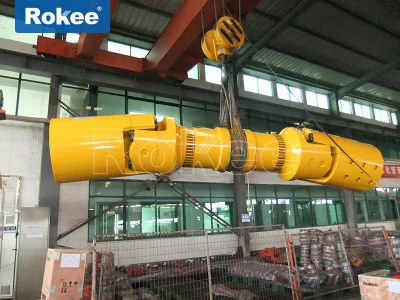
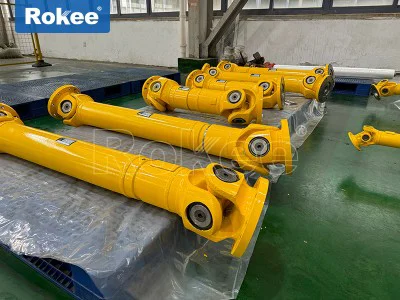
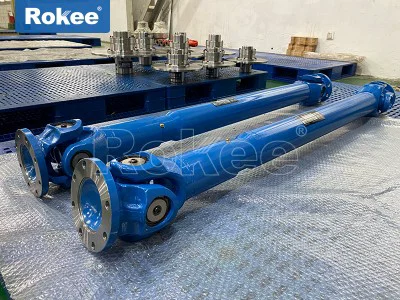
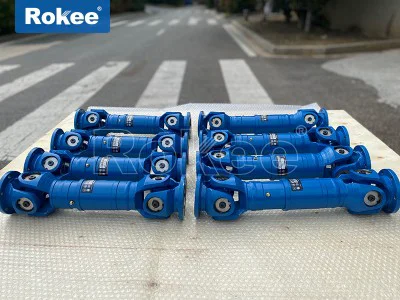
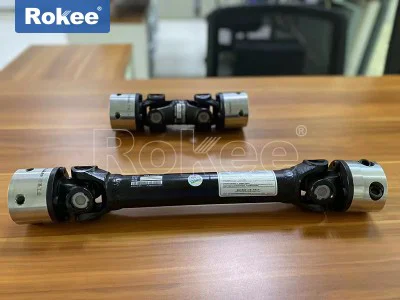
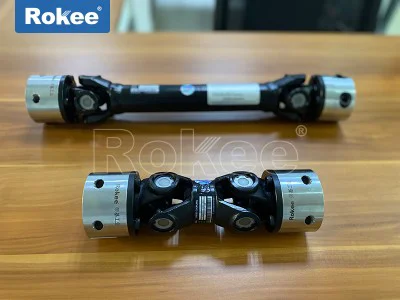
At its core, the universal joint shaft coupling operates on the principle of spatial linkage, leveraging a articulated design to maintain power transmission continuity despite angular offsets. The fundamental structure of a standard universal joint shaft coupling consists of several key integral parts, each crafted to withstand mechanical stress, reduce friction, and ensure long-term operational stability. The central element of most conventional universal joints is the cross-shaped spider, a robust component with four perpendicular arms that serve as mounting points for bearing assemblies. Flanking this spider are two yoke members, typically forged or machined from high-strength metallic alloys, each attached to one of the two shafts being connected. These yokes feature open, fork-like ends that cradle the cross spider, allowing for pivotal movement that accommodates angular misalignment between the shafts. Completing the basic assembly are precision bearing units, most commonly needle roller bearings, fitted onto each arm of the cross spider; these bearings minimize rotational friction between the spider and yokes, enabling smooth articulation and efficient power transfer while bearing radial and thrust loads generated during operation. Some advanced universal joint designs also incorporate sealing elements, such as dust caps or rubber gaskets, to shield internal bearing surfaces from contaminants like dust, debris, and moisture, preserving lubrication integrity and extending the service life of the assembly. For longer power transmission spans, universal joint shaft couplings often include an intermediate shaft section, which may be telescopic in some variants to adjust for axial displacement between the connected shafts, further enhancing the coupling’s versatility in accommodating installation tolerances and operational shifts.
The performance characteristics of universal joint shaft couplings are tailored to address the unique challenges of non-coaxial power transmission, balancing strength, flexibility, efficiency, and durability to meet diverse operational demands. One of the most defining performance traits is angular misalignment compensation, with standard models capable of accommodating shaft angles ranging from 5 degrees to 45 degrees, depending on the specific design and construction. This flexibility eliminates the need for ultra-precise shaft alignment during installation, reducing assembly time and costs while preventing excessive mechanical stress on connected equipment, such as motors, gearboxes, and driven machinery. Torque transmission capacity is another critical performance metric, with universal joint shaft couplings engineered to handle a broad spectrum of torque loads, from light-duty precision applications requiring minimal force to heavy-duty industrial operations that demand the transfer of massive rotational power. High-grade material selection and precision manufacturing further boost torque resistance, with components often crafted from hardened alloy steels, carbon steels, or specialized stainless steels that exhibit high tensile strength, fatigue resistance, and wear durability, ensuring the coupling can withstand repeated cyclic loading without deformation or failure.
Transmission efficiency is equally vital, and well-designed universal joint shaft couplings boast high energy transfer rates, typically ranging from 97% to 99.8%, minimizing power loss during operation and reducing overall energy consumption for the entire transmission system. While single universal joint configurations may exhibit minor speed fluctuations at larger shaft angles, a paired universal joint setup, with two joints linked by an intermediate shaft and aligned at specific geometric angles, eliminates this variability, delivering constant-velocity transmission critical for precision applications. Additional performance attributes include vibration damping and shock absorption capabilities, which help mitigate mechanical resonance and sudden load impacts, protecting sensitive components and reducing operational noise. Maintenance requirements vary by design, with robust, sealed universal joints offering extended service intervals and minimal upkeep, while more complex models may feature accessible bearing assemblies for straightforward lubrication or replacement. Environmental resilience is also a key performance factor, with many couplings engineered to perform reliably in extreme temperatures, humid conditions, or abrasive industrial environments, thanks to corrosion-resistant materials and effective sealing mechanisms that prevent internal damage.
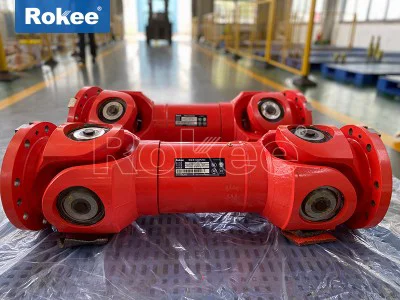
Universal joint shaft couplings are categorized into distinct types based on their structural design, operating principles, and intended performance profiles, each optimized for specific operational scenarios. The most prevalent and widely utilized variant is the cross-type universal joint, also known as the Cardan joint, which embodies the classic spider-and-yoke construction described earlier. This type is celebrated for its simple, rugged design, high load-bearing capacity, and ease of maintenance, making it the go-to choice for heavy-duty, low-to-medium speed applications. Cross-type universal joints are further subdivided based on yoke and bearing housing configurations, including integral fork head designs for maximum structural strength and split bearing housing designs that simplify disassembly and repair. While single cross joints have limitations in constant-velocity transmission, paired cross joint assemblies resolve this issue, making them suitable for a vast array of industrial settings where heavy torque transfer and moderate angular compensation are required.
A second major category is the constant-velocity (CV) universal joint, engineered to deliver perfectly synchronized rotational speed between driving and driven shafts regardless of the shaft angle, eliminating the speed fluctuations inherent to single cross-type joints. CV joints feature a more intricate design, typically incorporating a spherical outer race, a star-shaped inner race, a precision cage, and multiple torque-transmitting steel balls positioned along curved raceways. The cage maintains uniform ball positioning, ensuring the center of each ball lies on the bisector of the angle between the two shafts, enabling smooth, constant-velocity power transfer even at high rotational speeds and larger shaft angles, often exceeding 30 degrees. This design offers exceptional operational smoothness, low noise output, and high dynamic balance, making it ideal for high-speed precision applications. CV joints are further split into fixed and plunging variants; fixed CV joints accommodate angular misalignment only, while plunging CV joints handle both angular and axial displacement, adding versatility for systems with dynamic shaft movement.
The ball-fork universal joint represents a third prominent type, striking a balance between the ruggedness of cross-type joints and the constant-velocity performance of CV joints. This design features two fork-shaped end components and a central torque-transmitting steel ball, creating a simplified constant-velocity structure that is more cost-effective to manufacture than complex CV joints while offering reliable angular compensation. Ball-fork joints excel in medium-to-low speed, heavy-load scenarios, providing robust torque transfer and moderate angular flexibility, though they are less suited for extremely high-speed operation compared to CV joints. Additionally, there are specialized universal joint variants, including triple-pin joints, convex block joints, and ball plunging joints, each tailored to niche applications with unique operational demands, such as extreme angular misalignment, frequent axial movement, or heavy shock load absorption. These specialized designs expand the utility of universal joint shaft couplings, ensuring a suitable option exists for nearly every non-coaxial power transmission challenge.
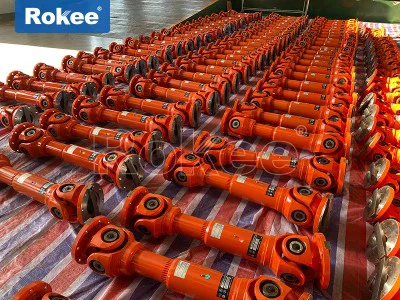
The versatility of universal joint shaft couplings translates to an extensive range of practical applications across nearly every sector of mechanical engineering, spanning heavy industry, automotive engineering, precision manufacturing, agriculture, construction, and beyond. In heavy industrial settings, such as metallurgical plants, mining operations, and steel rolling mills, cross-type universal joints dominate, thanks to their exceptional torque capacity and durability. These couplings connect large motors, gearboxes, and heavy processing equipment, reliably transferring massive rotational forces while compensating for the significant shaft misalignment that often occurs in large-scale industrial machinery due to structural deformation and heavy loading. They are also integral to material handling equipment, including cranes, conveyors, and hoists, enabling smooth power transfer in systems where shaft alignment is difficult to maintain.
Automotive engineering relies heavily on both cross-type and constant-velocity universal joints, with CV joints serving as critical components in drive axle assemblies, particularly for front-wheel-drive and all-wheel-drive vehicles. These joints transmit power from the transmission to the drive wheels while accommodating the constant angular changes caused by steering maneuvers and suspension movement, ensuring smooth, stable power delivery at high speeds and tight turning angles. Cross-type universal joints are commonly used in vehicle drive shafts and steering systems, providing reliable torque transfer and angular compensation in more rugged automotive applications. In agricultural machinery, such as tractors, harvesters, and tillers, universal joint shaft couplings are essential for connecting power take-off (PTO) shafts to various implements, enduring harsh outdoor conditions, heavy loads, and frequent angular shifts as equipment moves across uneven terrain.
Precision manufacturing and industrial machinery benefit immensely from constant-velocity universal joints, which deliver smooth, vibration-free power transmission critical for high-precision equipment. Machine tools, packaging machinery, textile manufacturing equipment, and robotic assembly systems all utilize CV joints to maintain operational accuracy, as even minor speed fluctuations or vibrations can compromise product quality and machining precision. Light-duty universal joints also find use in small-scale mechanical devices, including power tools, office equipment, and medical machinery, where compact size, flexible alignment, and reliable torque transfer are prioritized. Construction machinery, such as excavators, bulldozers, and concrete mixers, depends on heavy-duty universal joints to withstand the extreme loads, shock impacts, and harsh job site conditions, ensuring consistent power delivery to vital working components despite frequent movement and misalignment.
Beyond these core sectors, universal joint shaft couplings play vital roles in marine engineering, connecting propulsion systems and auxiliary equipment on vessels while compensating for hull flexing and shaft misalignment in marine environments. They are also used in aerospace support equipment, pumping systems, compressor drives, and renewable energy machinery, such as wind turbine drive trains, where they accommodate shaft misalignment caused by wind-induced structural movement. Across every application, the universal joint shaft coupling’s core value remains consistent: it solves the fundamental challenge of transmitting rotational power between non-aligned shafts, enhancing the flexibility, reliability, and longevity of mechanical systems while reducing the constraints of precise shaft alignment. As mechanical engineering continues to evolve, with demands for more efficient, durable, and adaptable transmission systems growing, the universal joint shaft coupling will remain a pivotal component, with ongoing advancements in materials, design, and manufacturing further refining its performance and expanding its potential applications across emerging industries.