GICL Barrel Gear Coupling
GICL drum gear coupling has larger inner teeth width, which can transfer torque while compensating for larger axial displacement.
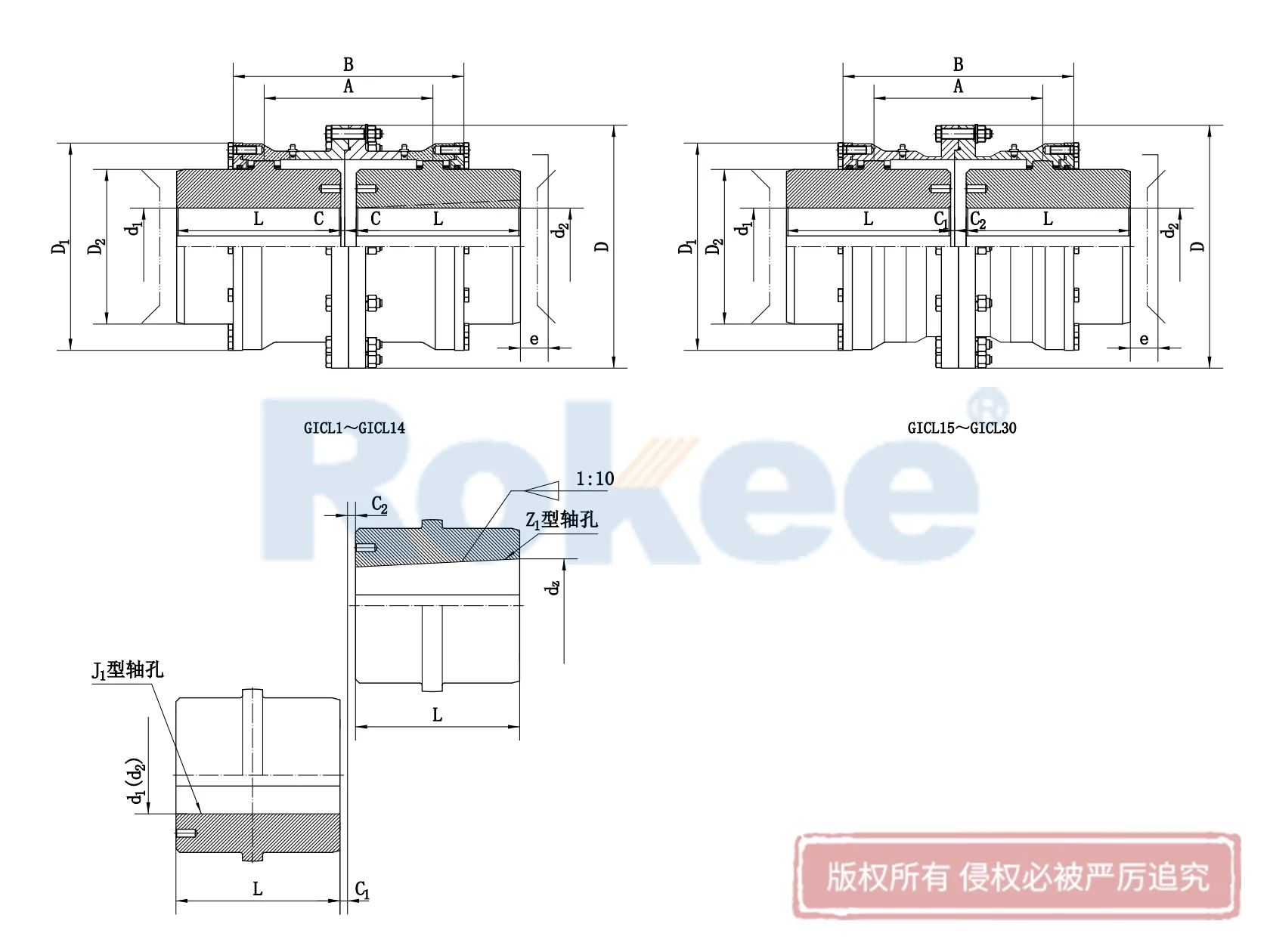
| Model | Rated Torque | Allowable Rotating Speed | Shaft Hole Diameter | Shaft Hole Length L | D | D1 | D2 | B | A | C | C1 | C2 | e | Allowable Radial Compensation Amount | Rotational Inertia | Quality | |
|---|---|---|---|---|---|---|---|---|---|---|---|---|---|---|---|---|---|
| d1、d2 | Y | J1、Z1 | |||||||||||||||
| L | |||||||||||||||||
| kN ·m | rpm | mm | △Y | kg ·m² | kg | ||||||||||||
| GICL1 | 0.8 | 7100 | 16,18,19 | 42 | 一 | 125 | 95 | 60 | 115 | 75 | 20 | 一 | 一 | 30 | 1.96 | 0.009 | 5.9 |
| 20,22,24 | 52 | 38 | 10 | 一 | 24 | ||||||||||||
| 25,28 | 62 | 44 | 2.5 | 一 | 19 | ||||||||||||
| 30,32,35,38 | 82 | 60 | 15 | 22 | |||||||||||||
| GICL2 | 1.4 | 6300 | 25,28 | 62 | 44 | 145 | 120 | 75 | 135 | 88 | 10.5 | 12.5 | 29 | 30 | 2.36 | 0.02 | 9.7 |
| 30,32,35,38 | 82 | 60 | 2.5 | 一 | 30 | ||||||||||||
| 40,42,45,48 | 112 | 84 | 13.5 | 28 | |||||||||||||
| GICL3 | 2.8 | 5900 | 30,32,35,38 | 82 | 60 | 170 | 140 | 95 | 155 | 106 | 3 | 24.5 | 25 | 30 | 2.75 | 0.047 | 17.2 |
| 40,42,45,48,50,55,56 | 112 | 84 | 17 | 28 | |||||||||||||
| 60 | 142 | 107 | 35 | ||||||||||||||
| GICL4 | 5.0 | 5400 | 32,35,38 | 82 | 60 | 195 | 165 | 115 | 178 | 125 | 14 | 37 | 32 | 30 | 3.27 | 0.091 | 24.9 |
| 40,42,45,48,50,55,56 | 112 | 84 | 3 | 17 | 28 | ||||||||||||
| 60,63,65,70 | 142 | 107 | 35 | ||||||||||||||
| GICL5 | 8.0 | 5000 | 40,42,45,48,50,55,56 | 112 | 84 | 225 | 183 | 130 | 198 | 142 | 3 | 25 | 28 | 30 | 3.8 | 0.167 | 38 |
| 60,63,65,70,71,75 | 142 | 107 | 20 | 35 | |||||||||||||
| 80 | 172 | 132 | 22 | 43 | |||||||||||||
| GICL6 | 11.2 | 4800 | 48,50,55,56 | 112 | 84 | 240 | 200 | 145 | 218 | 160 | 6 | 35 | 35 | 30 | 4.3 | 0.267 | 48.2 |
| 60,63.65,70,71,75 | 142 | 107 | 4 | 20 | 35 | ||||||||||||
| 80,85,90 | 172 | 132 | 22 | 43 | |||||||||||||
| GICL7 | 15.0 | 4500 | 60,63,65,70,71,75 | 142 | 107 | 260 | 230 | 160 | 244 | 180 | 4 | 25 | 35 | 30 | 4.7 | 0.453 | 68.9 |
| 80,85,90,95 | 172 | 132 | 22 | 43 | |||||||||||||
| 100 | 212 | 167 | 48 | ||||||||||||||
| GICL8 | 21.2 | 4000 | 65,70,71,75 | 142 | 107 | 280 | 245 | 175 | 264 | 193 | 5 | 35 | 35 | 30 | 5.24 | 0.646 | 83.3 |
| 80,85,90,95 | 172 | 132 | 22 | 43 | |||||||||||||
| 100,110 | 212 | 167 | 48 | ||||||||||||||
| GICL9 | 26.5 | 3500 | 70,71,75 | 142 | 107 | 315 | 270 | 200 | 284 | 208 | 10 | 45 | 45 | 30 | 5.63 | 1.036 | 110 |
| 80,85,90,95 | 172 | 132 | 5 | 22 | 43 | ||||||||||||
| 100,110,120,125 | 212 | 167 | 49 | ||||||||||||||
| GICL10 | 42.5 | 3200 | 80,85,90,95 | 172 | 132 | 345 | 300 | 220 | 330 | 249 | 5 | 43 | 43 | 30 | 6.81 | 1.88 | 157 |
| 100,110,120 | 212 | 167 | 22 | 49 | |||||||||||||
| 130,140 | 252 | 202 | 29 | 54 | |||||||||||||
| GICL11 | 60.0 | 3000 | 100,110,120 | 212 | 167 | 380 | 330 | 260 | 360 | 267 | 6 | 29 | 49 | 40 | 7.46 | 3.28 | 217 |
| 130,140,150 | 252 | 202 | 54 | ||||||||||||||
| 160 | 302 | 242 | 64 | ||||||||||||||
| GICL12 | 80.0 | 2600 | 120 | 212 | 167 | 440 | 380 | 290 | 416 | 313 | 6 | 57 | 57 | 40 | 8.77 | 5.08 | 305 |
| 130,140,150 | 252 | 202 | 29 | 55 | |||||||||||||
| 160,170,180 | 302 | 242 | 68 | ||||||||||||||
| GICL13 | 112 | 2300 | 140,150 | 252 | 202 | 480 | 420 | 320 | 476 | 364 | 7 | 54 | 57 | 40 | 10.08 | 10.06 | 416 |
| 160,170,180 | 302 | 242 | 32 | 70 | |||||||||||||
| 190,200 | 352 | 282 | 80 | ||||||||||||||
| GICL14 | 160 | 2100 | 160,170,180 | 302 | 242 | 520 | 465 | 360 | 532 | 415 | 8 | 42 | 70 | 40 | 11.15 | 16.774 | 594 |
| 190,200,220 | 352 | 282 | 32 | 80 | |||||||||||||
| GICL15 | 224 | 1900 | 190,200,220 | 352 | 282 | 580 | 510 | 400 | 556 | 429 | 10 | 34 | 80 | 40 | 11.36 | 26.55 | 783 |
| 240,250 | 410 | 330 | 38 | 一 | |||||||||||||
| GICL16 | 355 | 1600 | 200,220 | 352 | 282 | 680 | 595 | 465 | 640 | 501 | 10 | 58 | 80 | 50 | 13.3 | 52.22 | 1134 |
| 240,250,260 | 410 | 330 | 38 | 一 | |||||||||||||
| 280 | 470 | 380 | 38 | 一 | |||||||||||||
| GICL17 | 400 | 1500 | 220 | 352 | 282 | 720 | 645 | 495 | 672 | 512 | 10 | 74 | 80 | 50 | 13.87 | 69 | 1305 |
| 240,250,260 | 410 | 330 | 39 | 一 | |||||||||||||
| 280,300 | 470 | 380 | 39 | ||||||||||||||
| GICL18 | 500 | 1400 | 240,250,260 | 410 | 330 | 775 | 675 | 520 | 702 | 524 | 10 | 46 | 一 | 50 | 14.53 | 96.16 | 1626 |
| 280,300,320 | 470 | 380 | 41 | ||||||||||||||
| GICL19 | 630 | 1300 | 260 | 410 | 330 | 815 | 715 | 560 | 744 | 560 | 10 | 67 | 一 | 50 | 15.71 | 115.6 | 1773 |
| 280,300,320 | 470 | 380 | 41 | ||||||||||||||
| 340 | 550 | 450 | |||||||||||||||
| GICL20 | 710 | 1200 | 280,300,320 | 470 | 380 | 855 | 755 | 585 | 786 | 595 | 13 | 44 | 一 | 50 | 16.49 | 167.41 | 2263 |
| 340,360 | 550 | 450 | 44 | ||||||||||||||
| GICL21 | 900 | 1100 | 300,320 | 470 | 380 | 915 | 795 | 620 | 808 | 611 | 13 | 59 | 一 | 50 | 17.02 | 215.7 | 2593 |
| 340,360,380 | 550 | 450 | 44 | ||||||||||||||
| GICL22 | 950 | 950 | 340,360,380 | 550 | 450 | 960 | 840 | 665 | 830 | 632 | 13 | 44 | 一 | 60 | 17.28 | 278.07 | 3036 |
| 400 | 650 | 540 | 44 | ||||||||||||||
| GICL23 | 1120 | 900 | 360,380 | 550 | 450 | 1010 | 890 | 710 | 870 | 666 | 13 | 44 | 一 | 60 | 18.06 | 379.4 | 3668 |
| 400,420 | 650 | 540 | 48 | ||||||||||||||
| GICL24 | 1250 | 875 | 380 | 550 | 450 | 1050 | 925 | 730 | 890 | 685 | 15 | 46 | 一 | 60 | 18.6 | 448.1 | 3964 |
| 400,420,450 | 650 | 540 | 50 | ||||||||||||||
| GICL25 | 1400 | 850 | 400,420,450,480 | 650 | 540 | 1120 | 970 | 770 | 930 | 724 | 15 | 50 | 一 | 60 | 19.4 | 564.64 | 4443 |
| GICL26 | 1600 | 825 | 420,450,480,500 | 650 | 540 | 1160 | 990 | 800 | 950 | 733 | 15 | 50 | 一 | 60 | 19.9 | 637.4 | 4791 |
| GICL27 | 1800 | 800 | 450,480,500 | 650 | 540 | 1210 | 1060 | 850 | 958 | 739 | 15 | 50 | 一 | 70 | 19.92 | 866.26 | 5758 |
| 530 | 800 | 680 | 50 | ||||||||||||||
| GICL28 | 2000 | 770 | 480,500 | 650 | 540 | 1250 | 1080 | 890 | 1034 | 805 | 20 | 55 | 一 | 70 | 21.2 | 1020.76 | 6232 |
| 530,560 | 800 | 680 | 55 | ||||||||||||||
| GICL29 | 2800 | 725 | 500 | 650 | 540 | 1340 | 1200 | 960 | 1034 | 792 | 20 | 57 | 一 | 80 | 21.1 | 1450.84 | 7549 |
| 530,560,600 | 800 | 680 | 55 | ||||||||||||||
| GICL30 | 3200 | 700 | 560,600,630 | 800 | 680 | 1390 | 1240 | 1005 | 1050 | 806 | 20 | 55 | 一 | 80 | 21.7 | 1947.17 | 9541 |
In the intricate landscape of industrial power transmission, barrel gear couplings stand as indispensable mechanical components, bridging the gap between rotating shafts to facilitate seamless torque transfer while addressing the common challenge of shaft misalignment. Unlike basic rigid couplings that demand pinpoint shaft alignment and offer no tolerance for positional deviations, gicl gear couplings blend robust torque-carrying capabilities with flexible misalignment compensation, making them a staple in heavy-duty and precision-driven machinery across countless industrial sectors. Their unique design, tailored performance attributes, diverse structural variations, and wide-ranging applicability have cemented their status as a go-to solution for engineers and operators seeking reliable, long-lasting power transmission components.
At its core, the gicl barrel gear coupling is a rigid-flexible transmission component, defined by its distinctive barrel-shaped external gear teeth that form a spherical profile with the sphere’s center aligned precisely along the gear’s central axis. This signature geometric design is the foundation of its exceptional performance, setting it apart from conventional straight-tooth gear couplings and other standard coupling types. The fundamental structure of a typical barrel gear coupling comprises four key integral parts: two shaft-mounted half-couplings, an outer sleeve fitted with internal gear teeth, and a dedicated sealing assembly. Each half-coupling is engineered to attach securely to either the driving or driven shaft, featuring the characteristic spherical barrel-shaped external teeth that mesh seamlessly with the internal teeth of the outer sleeve. The tooth clearance in barrel gear couplings is intentionally engineered to be slightly greater than that of standard gear couplings, a design choice that not only enhances misalignment accommodation but also prevents tooth jamming during continuous operation, ensuring smooth rotational motion even under suboptimal shaft alignment conditions.
Material selection plays a pivotal role in defining the durability and load-bearing capacity of barrel gear couplings, with high-strength alloy steel being the most prevalent material choice for mainstream industrial applications. These alloy steels undergo rigorous heat treatment processes, including quenching and tempering, to boost surface hardness, core toughness, and wear resistance, enabling the coupling to withstand heavy torque loads, repetitive mechanical stress, and prolonged operational wear without compromising structural integrity. For specialized operating environments, such as marine facilities, chemical processing plants, or offshore installations where corrosion is a persistent threat, corrosion-resistant materials like stainless steel are employed to mitigate degradation from moisture, chemical fumes, and saline conditions. The sealing system, typically composed of high-performance lip seals, protective cover plates, and retaining components, serves two critical functions: it blocks the ingress of external contaminants such as dust, debris, moisture, and industrial pollutants, and it retains the internal lubricant—usually high-grade grease or lubricating oil—that minimizes friction between meshing gear teeth, reduces heat generation, and extends the service life of the entire coupling assembly. Some advanced designs also incorporate integrated wear indicators, either mechanical or visual, allowing operators to monitor tooth wear and component degradation proactively, preventing unexpected failures and costly unplanned downtime.
The operating principle of barrel gear couplings revolves around the meshing interaction between the spherical barrel teeth of the half-couplings and the internal teeth of the outer sleeve, enabling efficient torque transmission between two shafts that may not be perfectly aligned. When the driving shaft initiates rotation, it transfers motion to the attached half-coupling, whose barrel teeth engage with the outer sleeve’s internal teeth to drive the sleeve into rotation. This rotational force is then relayed to the second half-coupling connected to the driven shaft, completing the torque transfer cycle. The true advantage of the barrel tooth design manifests in its ability to accommodate multiple forms of shaft misalignment simultaneously, a capability that is invaluable in real-world industrial settings where perfect alignment is rarely achievable due to installation errors, thermal expansion and contraction, structural deformation of machinery frames, or operational vibration. For angular misalignment, where the two shafts intersect at a slight angle rather than sharing a collinear axis, the spherical curvature of the barrel teeth maintains consistent tooth contact across the meshing surface, eliminating localized stress concentrations and preventing premature tooth wear. For radial misalignment, where shafts are parallel but offset horizontally, the increased tooth clearance and spherical profile allow for subtle lateral sliding of the meshing teeth without disrupting torque flow. Axial misalignment, caused by shaft elongation or contraction during operation, is also absorbed effectively, as the meshing teeth can accommodate small axial displacements while maintaining reliable power transmission.
In terms of core performance characteristics, barrel gear couplings excel in several key metrics that make them highly versatile for industrial use. Foremost is their exceptional high torque transmission capacity, engineered to handle heavy-duty load requirements in large-scale machinery, with the robust gear tooth design and high-strength materials enabling them to transfer substantial rotational force without deformation or failure. Their misalignment compensation capability is equally noteworthy, as they can accommodate moderate to significant angular, radial, and axial misalignments simultaneously, reducing the need for ultra-precise installation and minimizing wear on connected shafts, bearings, and other drivetrain components. Despite their flexible misalignment tolerance, barrel gear couplings maintain high torsional rigidity, ensuring minimal backlash and precise rotational synchronization between driving and driven shafts—an essential trait for applications requiring accurate motion control, such as conveyor systems, rolling mills, and machine tools. Additionally, these couplings offer reliable operational stability, low noise output during rotation, and simplified maintenance requirements; the sealed design retains lubrication effectively, reducing the frequency of relubrication, and the rugged construction resists damage from harsh operating conditions, from extreme temperatures to heavy dust exposure. Over time, this combination of performance features translates to extended service life, reduced maintenance costs, and enhanced overall operational efficiency for the machinery they integrate with.
Barrel gear couplings are categorized into distinct types based on multiple criteria, including structural design, flexibility characteristics, installation orientation, and application-specific adaptations, each tailored to meet unique operational demands. One of the most common classification methods is based on operational flexibility, dividing the couplings into rigid barrel gear couplings and flexible barrel gear couplings. Rigid variants rely exclusively on the spherical barrel tooth profile for misalignment compensation, with no additional elastic components; they prioritize maximum torque capacity and torsional stiffness, making them ideal for heavy-duty applications where misalignment is minimal but load demands are extreme, such as mining equipment, steel rolling mills, and large industrial compressors. Flexible barrel gear couplings, by contrast, integrate elastic elements—such as rubber pads, elastomeric sleeves, or resilient buffers—between the half-couplings and the outer sleeve. These elastic components enhance vibration and shock absorption, dampening mechanical noise and reducing the transfer of harmful vibrations from the driving shaft to the driven shaft and connected machinery. This makes flexible models well-suited for applications where vibration control is critical, such as wind turbines, water pumps, generators, and precision manufacturing equipment, as they protect sensitive components from fatigue and premature wear.
Another key classification is based on installation orientation, distinguishing between horizontal and vertical barrel gear couplings. Horizontal installation models are the most widely used, designed for standard horizontal shaft arrangements common in most industrial machinery, including conveyors, mixers, crushers, and general-purpose machine tools; their design prioritizes stable torque transmission and efficient compensation for horizontal misalignments, with balanced load distribution to support consistent operation. Vertical installation couplings are engineered specifically for vertical shaft setups, such as vertical pumps, vertical turbines, and certain crane hoisting mechanisms. These models feature specialized structural modifications to counteract the effects of gravity on internal components, ensuring proper gear meshing and lubricant distribution even in a vertical orientation, with enhanced sealing systems to prevent lubricant leakage and maintain consistent performance. Additional specialized types include high-temperature resistant barrel gear couplings, built with heat-resistant alloys and high-temperature lubricants to operate reliably in extreme heat environments like furnaces, steam turbines, and exhaust systems; torsion-protected couplings, equipped with overload safety features such as shear pins or torsion limiters to shield the coupling and connected machinery from sudden torque spikes or jams; and corrosion-resistant couplings, fabricated with stainless steel or coated alloys for use in chemical, marine, and offshore environments where moisture and corrosive substances are prevalent.
The diverse performance and structural variations of gicl drum gear couplings enable their deployment across a vast spectrum of industrial sectors, addressing unique power transmission challenges in each field. In the mining and heavy machinery industry, these couplings are integral to excavators, belt conveyors, crushing equipment, and grinding mills, where they handle extreme torque loads, withstand heavy vibration, and accommodate misalignments caused by the rugged, dynamic operating conditions of mining sites. Their rugged construction resists dust, debris, and mechanical shock, ensuring uninterrupted operation in harsh underground and open-pit mining environments. In the steel and metallurgical sector, barrel gear couplings are essential components in rolling mills, blast furnaces, continuous casting machines, and metal processing equipment, transmitting extremely high torques while tolerating thermal expansion-induced misalignments and high operating temperatures; rigid models are particularly favored here for their unmatched load-bearing capacity and torsional stability.
Crane and hoisting equipment relies heavily on barrel gear couplings to connect reducer output shafts to cable drums, where they transmit the torque needed for lifting and lowering heavy loads while restricting axial drum movement for safe, stable operation. The ability to bear radial loads generated by lifting cables and accommodate minor misalignments from structural movement makes them indispensable for gantry cranes, overhead cranes, winches, and other material handling machinery. In the energy and power generation industry, barrel gear couplings find use in thermal power plants, hydropower facilities, wind farms, and other renewable energy installations; flexible models are widely used in wind turbines to absorb rotor-induced vibrations and compensate for misalignments from variable wind loads, while standard models connect turbine and generator shafts in power plants, ensuring reliable power output. The chemical and petroleum industry utilizes corrosion-resistant barrel gear couplings in pumps, compressors, mixers, and pipeline equipment, where they withstand corrosive chemicals, high pressure, and extreme temperatures, maintaining leak-free, reliable torque transmission in hazardous operating environments.
Beyond these heavy-duty sectors, gicl crown gear couplings are also widely employed in general manufacturing, food processing, textile machinery, and marine applications, adapting to varying load requirements, environmental conditions, and alignment challenges. In general manufacturing, they support lathes, milling machines, grinders, and assembly line conveyors, delivering precise torque transfer and accommodating minor misalignments from routine wear and temperature fluctuations. In marine settings, they power shipboard machinery, including propulsion systems, pumps, and winches, with corrosion-resistant designs enduring saltwater exposure and harsh maritime conditions. Regardless of the industry, the core value of barrel gear couplings remains consistent: they provide a reliable, efficient, and durable link between rotating shafts, mitigating the operational risks posed by misalignment and heavy loads while enhancing the longevity and performance of the entire mechanical system.
As industrial technology continues to advance, the design and application of gicl curved tooth couplings are evolving to meet increasingly stringent operational demands, with ongoing innovations in material science, precision manufacturing, and smart monitoring further elevating their performance. Modern advancements focus on optimizing gear tooth profiles for reduced friction and higher efficiency, developing lightweight yet high-strength materials to cut energy consumption, and integrating sensor-based monitoring systems for real-time tracking of temperature, vibration, and wear. These developments not only enhance the functionality of barrel gear couplings but also expand their applicability into more specialized and demanding industrial scenarios. From heavy industrial manufacturing to renewable energy generation, barrel gear couplings will continue to play a vital role in powering the world’s machinery, embodying the perfect balance of strength, flexibility, and reliability that is essential for efficient industrial power transmission. Their enduring relevance stems from their ability to adapt to diverse operational needs, solve real-world mechanical challenges, and deliver consistent performance in even the most demanding environments, solidifying their position as a cornerstone component in modern industrial engineering.