In the vast and intricate landscape of mechanical power transmission, couplings serve as indispensable connecting components that bridge two rotating shafts, enabling the efficient transfer of torque while accommodating certain operational deviations. Among the diverse array of coupling types available, the GL roller chain coupling stands out as a widely adopted solution, celebrated for its straightforward design, robust durability, and exceptional adaptability across varied industrial scenarios. Unlike complex precision couplings that demand stringent installation conditions, this type of coupling integrates the mechanical advantages of roller chain transmission and sprocket engagement, striking a perfect balance between functional reliability and operational flexibility. It has carved out a unique niche in low-to-medium speed, high-torque transmission systems, addressing the core needs of countless mechanical setups where stable power delivery and tolerance for minor misalignments are paramount. Delving into its structural composition, performance attributes, classification criteria, and real-world applications not only unveils the engineering logic behind its popularity but also provides valuable insights for optimal selection and utilization in practical engineering projects.
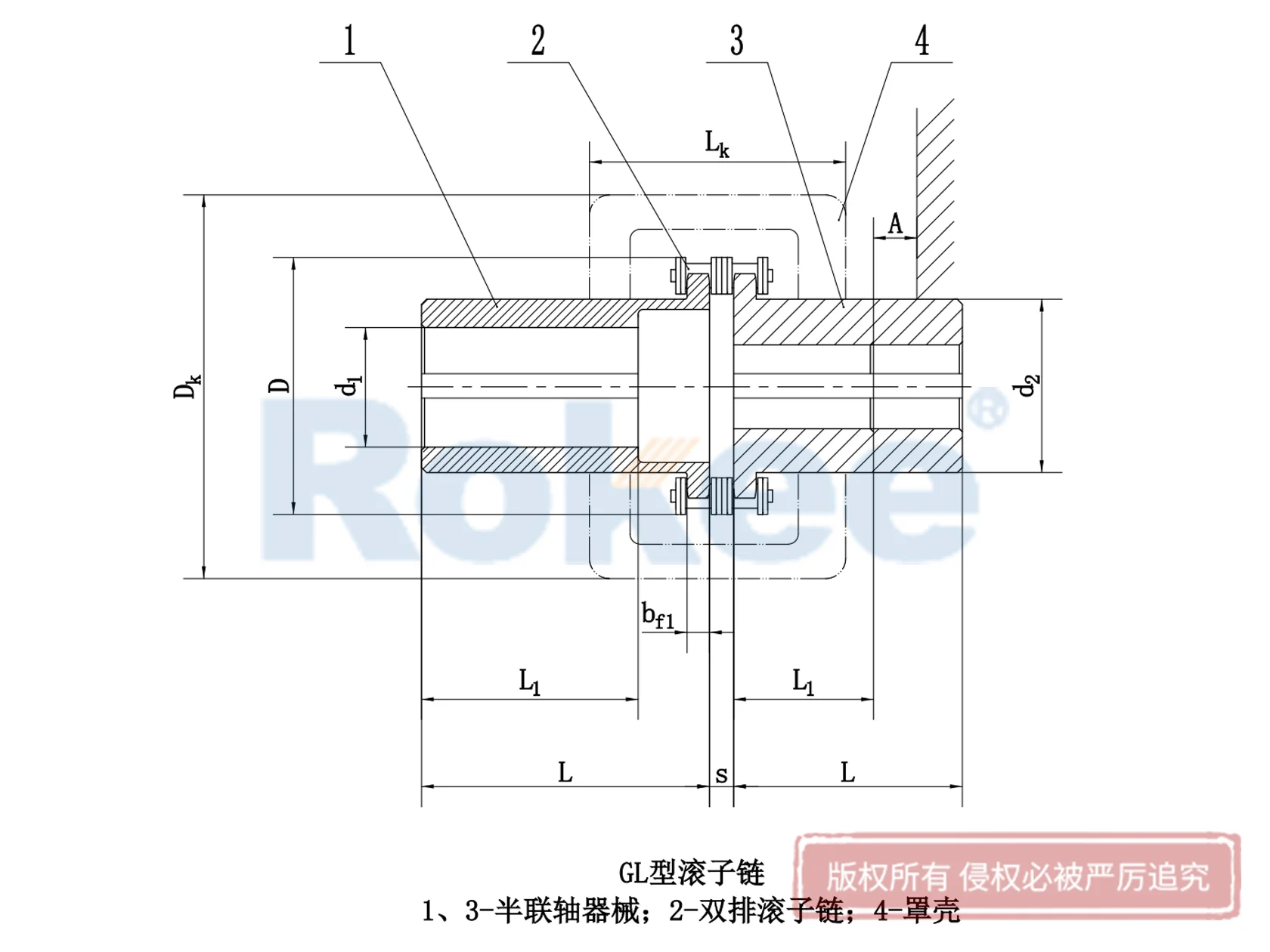
At its core, the GL roller chain coupling features a simplified yet highly efficient structural design, composed of a minimal number of key components that work in seamless harmony to fulfill power transmission tasks. The fundamental structure revolves around two identically sized sprockets, a matched roller chain, and essential auxiliary parts including fasteners and protective enclosures. Each sprocket is precisely machined to fit the corresponding shaft diameter, featuring keyway slots or other secure connection mechanisms to ensure a tight, non-slip bond with the driving and driven shafts respectively. The roller chain, engineered to mesh perfectly with the tooth profiles of both sprockets, acts as the critical torque-carrying medium, wrapping around the two sprockets to form a closed transmission loop. This modular construction eliminates redundant complex parts, making the coupling compact in size and lightweight in mass, without compromising its load-bearing capacity. One of the most notable structural merits is its tool-friendly disassembly and assembly process; maintenance personnel can install, remove, or replace the coupling without shifting the positions of the connected shafts or disassembling adjacent equipment, drastically cutting down on maintenance time and labor costs, and minimizing equipment downtime during routine upkeep or emergency repairs.
The structural design of the GL roller chain coupling is further refined to enhance operational stability and longevity. The sprockets are typically crafted from high-quality alloy steel or carbon steel, subjected to specialized heat treatment processes such as quenching and tempering to boost surface hardness, wear resistance, and impact toughness. This thermal processing ensures that the sprocket teeth can withstand repeated friction and stress from chain engagement without rapid deformation or wear, even under prolonged heavy-duty operation. The roller chain, a core load-bearing element, is constructed with precision-machined inner and outer link plates, sturdy rollers, and durable pins, each component engineered to tight tolerances to guarantee smooth meshing with sprockets and efficient torque transmission. The chain’s flexible structure allows for slight angular and radial movements, which is the foundational principle behind the coupling’s misalignment compensation capability. Additionally, most GL roller chain couplings are equipped with a protective cover, usually made of stamped steel or lightweight alloy, that encloses the chain-sprocket meshing area. This cover serves multiple vital purposes: it prevents the accumulation of dust, debris, moisture, and other contaminants from infiltrating the transmission interface, avoiding accelerated wear and corrosion; it contains lubricating grease within the coupling, reducing lubricant loss and ensuring consistent lubrication for moving parts; and it also enhances operational safety by preventing accidental contact with the rotating chain and sprockets, eliminating potential workplace hazards.
The performance characteristics of the GL roller chain coupling are directly shaped by its structural design, making it a versatile component tailored for harsh and demanding industrial environments. Foremost among its performance advantages is its exceptional torque transmission capacity, optimized for low-to-medium speed operation. The direct meshing between chain and sprocket eliminates the power loss associated with friction-based or elastic transmission, enabling high-efficiency torque delivery even under heavy load conditions. This makes it particularly suitable for heavy-duty machinery that requires consistent, high-torque output without speed fluctuations. Secondly, the coupling exhibits remarkable misalignment compensation performance, a critical trait for real-world engineering applications where perfect shaft alignment is often unattainable. It can effectively accommodate slight radial displacement, axial displacement, and angular misalignment between the two connected shafts, which commonly arise from installation errors, thermal expansion during operation, mechanical vibration, or structural deformation. By absorbing these minor deviations, the coupling prevents excessive stress buildup on the shafts, bearings, and other connected components, reducing wear and tear, minimizing vibration and noise, and extending the service life of the entire transmission system.
Environmental adaptability is another standout performance feature of the GL roller chain coupling, setting it apart from many precision couplings that are limited to controlled working conditions. It can operate reliably in extreme temperatures, ranging from frigid low-temperature environments to high-temperature industrial settings, without significant degradation in performance. Its sturdy construction also allows it to function steadily in dusty, humid, or mildly corrosive atmospheres, such as mining sites, outdoor construction zones, and agricultural fields, where delicate transmission components would quickly fail. Furthermore, the coupling offers outstanding operational stability and low maintenance requirements. With proper initial lubrication and regular periodic maintenance, it can sustain long hours of uninterrupted operation with minimal performance fluctuations. The wear-resistant materials used in its construction slow down the aging process of core components, and in the event of localized wear, only the worn chain or sprocket needs replacement, rather than the entire coupling, which significantly reduces long-term operational and maintenance costs for industrial enterprises. It is important to note, however, that this coupling is not designed for high-speed rotational applications; excessive operating speeds can induce centrifugal force-induced chain slack, increased noise, and accelerated wear, so it is primarily deployed in systems with moderate rotational speeds where its performance advantages are fully realized.
GL roller chain couplings are categorized into distinct types based on structural variations and application-specific requirements, each tailored to meet different load, space, and operational demands. The most fundamental classification is based on the number of chain rows, dividing the couplings into single-row roller chain couplings and double-row roller chain couplings. Single-row GL roller chain couplings feature a single roller chain meshing with two sprockets, offering a more compact profile and lighter weight. This type is ideal for small-scale mechanical systems, light-load transmission scenarios, or equipment with limited installation space, providing reliable power transmission for low-torque applications while maintaining cost-effectiveness. Double-row GL roller chain couplings, by contrast, utilize two parallel roller chains to engage with the sprockets, effectively doubling the contact area between chains and sprockets. This design substantially enhances the coupling’s torque-bearing capacity, shear resistance, and overall structural rigidity, making it the preferred choice for medium-to-heavy duty industrial machinery that handles higher loads and greater operational stress. The double-row configuration also improves operational stability, distributing the transmission load evenly and reducing the risk of single-chain failure, thus boosting the reliability of the entire transmission system.
Additional classifications of GL roller chain couplings are based on specialized structural modifications and application scenarios, further expanding their versatility. Some variants are designed with enhanced sealing performance, featuring upgraded protective covers and sealing elements to prevent lubricant leakage and block external contaminants more effectively, making them suitable for humid, dusty, or mildly corrosive environments such as chemical processing plants, wastewater treatment facilities, and agricultural machinery. Other variants are optimized for compactness, with reduced overall dimensions and streamlined sprocket designs to fit into extremely space-constrained mechanical setups, such as small automated machinery, portable equipment, and precision mechanical transmission systems. There are also custom-engineered GL roller chain couplings adapted for specific load characteristics, such as those with improved shock absorption capabilities to handle frequent startup, shutdown, and load fluctuation scenarios, protecting the transmission system from sudden impact damage. Despite these structural variations, all types retain the core advantages of the GL roller chain coupling: simple construction, easy installation, reliable performance, and cost efficiency, ensuring they can be adapted to a wide spectrum of industrial transmission needs.
The exceptional combination of structural simplicity, reliable performance, and flexible classification makes GL roller chain couplings extensively applied across nearly all sectors of industrial manufacturing and mechanical engineering, serving as a cornerstone component in countless power transmission systems. In the mining and quarrying industry, these couplings are widely integrated into heavy machinery such as crushers, conveyors, vibrating screens, and hoists. The harsh operating conditions of mining sites—characterized by heavy loads, continuous operation, dust, and vibration—are well-suited to the coupling’s high torque capacity, environmental resilience, and low maintenance needs, ensuring stable power delivery and minimizing equipment failures in critical production processes. In the construction machinery sector, GL roller chain couplings are utilized in concrete mixers, asphalt pavers, lifting equipment, and various construction vehicles, where their ability to compensate for shaft misalignment and withstand shock loads ensures reliable performance in rugged outdoor construction environments, supporting the efficient operation of essential construction equipment.
The agricultural machinery industry also relies heavily on GL roller chain couplings for a wide range of equipment, including tractors, harvesters, seeders, and irrigation systems. Agricultural machinery often operates in outdoor, dusty, and humid fields, requiring transmission components that are durable, easy to maintain, and cost-effective. The coupling’s robust construction and environmental adaptability make it perfectly suited to these conditions, providing stable power transmission for agricultural equipment and supporting efficient farming operations. In the light industrial manufacturing sector, encompassing textile machinery, printing machinery, packaging machinery, and woodworking equipment, GL roller chain couplings deliver smooth, reliable torque transmission for medium-load applications. Their compact size and easy installation make them ideal for integrated production lines, where space optimization and equipment maintainability are critical, ensuring the smooth operation of automated manufacturing processes and enhancing production efficiency.
Beyond these core industries, GL roller chain couplings find valuable applications in transportation equipment, chemical processing machinery, water treatment systems, and various general mechanical devices. In transportation machinery, they are used in conveyor systems, port handling equipment, and automotive assembly lines, facilitating efficient material handling and production logistics. In chemical and water treatment facilities, their corrosion-resistant variants withstand mildly corrosive media, ensuring stable operation in fluid transmission and processing equipment. Even in small-scale mechanical setups and custom-built machinery, the coupling’s versatility shines through, as its modular design and easy adaptability make it a go-to choice for engineers designing reliable, cost-effective power transmission solutions. Across every application scenario, the GL roller chain coupling proves its worth by delivering consistent performance, reducing maintenance burdens, and enhancing the overall reliability and efficiency of the mechanical systems it serves.
In summary, the GL roller chain coupling represents a paradigm of practical engineering design, merging simplified structural composition with high-performance functional attributes to meet the diverse demands of modern industrial power transmission. Its well-engineered structure, featuring minimal components, easy maintenance, and durable materials, lays the groundwork for reliable operation; its core performance traits, including high torque transmission, misalignment compensation, and exceptional environmental adaptability, address the key challenges of real-world industrial applications; its diverse classification system ensures compatibility with a wide range of load conditions and equipment requirements; and its extensive cross-industry applications solidify its status as an indispensable component in the mechanical transmission field. As industrial technology continues to evolve and mechanical systems become increasingly sophisticated, the GL roller chain coupling will remain a vital solution, adapting to emerging engineering needs through continuous minor optimizations while retaining its core advantages. For engineers and industrial operators, a comprehensive understanding of its structure, performance, classification, and applications is essential for making informed coupling selection decisions, optimizing transmission system design, and achieving efficient, stable, and cost-effective mechanical operation in various industrial settings.